The 4 Leadership Questions AI Can’t Answer
What do we need most from leaders in times of uncertainty? What kind of questions should we be asking ourselves as leaders in the midst of so much change and disruption? What matters most now?
These are some of the questions I've been reflecting on and sharing in the keynotes I've been delivering. As someone who sustained a spinal fracture after being hit by a pickup truck in the midst of the pandemic, I know a thing or two about navigating disruption and uncertainty.
This week, I delivered a keynote about the didn't-see-it-coming moments we all face and how we can move beyond the blindsides to build trust, resilience, and hope in the people we lead and in ourselves.
I shared the story of Ashley, the neurosurgery physician assistant, who showed up at my bedside the day of the accident and shared her own story of a blindside moment that led her to relearn how to walk in her early 20s. She gave me something no other provider had given me all day — hope — when she looked at me and said, “You’re going to be okay.”
In the ten minutes she spent with me, she also gave me three other things that, according to Gallup, we need from leaders amid change and uncertainty:
Trust: I can count on you. I know you have my back.
Compassion: You care about me as a person.
Stability: You help me to feel safe and secure. Being consistent and transparent with communication and support are just a couple ways to foster stability.
Hope: You help me see that the future can be better and brighter than the present moment.
AI can't replicate those things. They are distinctly human qualities, and at the core of all four is the power of presence. When we show up with trust, compassion, stability, and hope, people feel supported, centered, and calm in our presence.
From there, I shared a new perspective I hadn't shared on stage before: the four leadership questions that AI can't answer, questions that help reinforce trust, compassion, stability and hope.
Q1: Who am I helping and why does it matter?
Q2: Who am I? What shows up when I do?
Q3: If it were just right, what would it look like?
Q4: What kind of person do I want to be?
And a bonus question: How can I be a contribution today?
Let's unpack each one.

Q1: Who am I helping and why does it matter?
At the core of this question are two things: purpose and relevance. At a time when over half of employees fear AI will take their jobs, we need to double down on this question more than we ever have. People are feeling increasingly irrelevant right now, and leadership guru Patrick Lencioni has found that relevance is one of the three keys to employee engagement. When we don't feel like what we do matters and feel unclear on who we're helping, we check out, coast, and eventually leave.
Take these questions back to the people you lead and reflect on them yourself:
Can you tell me about a time you made a difference or felt like your work mattered?
What is it about the work you do that is meaningful, purposeful or important to you, to those you serve, or to the wider world?
Purpose is a stabilizer, an anchor that keeps us steady when everything around us is changing.
Q2: Who am I? What shows up when I do?
For so many of us, especially high achievers, our work and our worth have become synonymous. So, when some aspect of our job changes or disappears, it doesn't just disrupt our calendar or paycheck. It disrupts our sense of self. That’s why it’s essential that leaders develop a sense of self-concept clarity, so they aren’t blind to their own brilliance. I wrote about that in depth in my last blog post here.
After burning out at 32 (while serving as the Director of Wellbeing at my company), I was deep in an identity crisis when an HR leader gave me two questions to ask the people who knew me well:
What shows up when I do?
What qualities do I bring into the room?
I called my friend Kara. My first instinct when she answered was to deflect part of what she said because I don’t always see myself the way she does. I'm not the only one who does that. Most of us deflect, dismiss, or diminish the affirming things people say about us. We reject instead of receiving, and when we do, it's like we're batting away a valuable gift someone is trying to give us.
Try this with your team. Ask them something they're proud of, value, or appreciate about themselves, about who they are, their personality, how they show up in the world. You'd be surprised how few people in their lives are ever asked that question. Two minutes. It's free. And it can change someone's entire day.
Q3: If it were just right, what would it look like?
This is my favorite possibility-activating question, and I learned it from my dad.
Three weeks after my accident, walking laps around a track in a back brace, I watched a one-armed man who was playing football with a friend make catch after catch, all with a smile on his face. He wasn't focused on what he didn't have. He was focused on what he could still do with what he did have.
That shift from problems to possibilities is a choice. So, when you're stuck or blindsided, ask yourself this question:
If it were just right, what would it look like?
Apply it anywhere: your team communication, your onboarding process, a struggling relationship with a colleague, your health and wellbeing. That question has a way of pulling us out of what's wrong and into what's possible.
One way we can unlock possibility in the midst of adversity is by turning a challenge into a lesson or positive perspective shift. Psychologists call this "post-traumatic growth." The choice we can make amid the blindside moments that puts us into a position of empowerment and agency is this:
Even though I didn't choose it, I'm going to find a way to use it.
The hard thing doesn't have to define you. You get to do that.
Q4: What kind of person do I want to be?
James Clear offers up this question in his book, Atomic Habits (one of my favorites). Most of us spend exponentially more time focused on what we're doing and not nearly enough time focused on who we're becoming or the legacy we're leaving.
After my accident, when a colleague in my industry offered to set up a meal train for my husband and me, my first instinct was to say, Oh, no thanks. We're fine. Pure self-sufficiency and pride. But I was waking up at 3am in muscle spasms, trying to rebuild a business I'd barely launched, while my husband was teaching online full-time and taking care of me, so the wiser part of me said yes.
For someone who’s always been fiercely independent, letting myself be loved in that way was one of the hardest yet most meaningful things I've ever done. I want to be the kind of person who receives support, help, and love without shame. I want to be the kind of person who doesn't try to do it all alone.
James Clear also writes, "Every action we take is a vote for the type of person we wish to become." So, what do your actions say about the type of person you wish to become? And what do you need to start, stop, or continue doing to become that kind of person you’ll be proud of ten years from now?
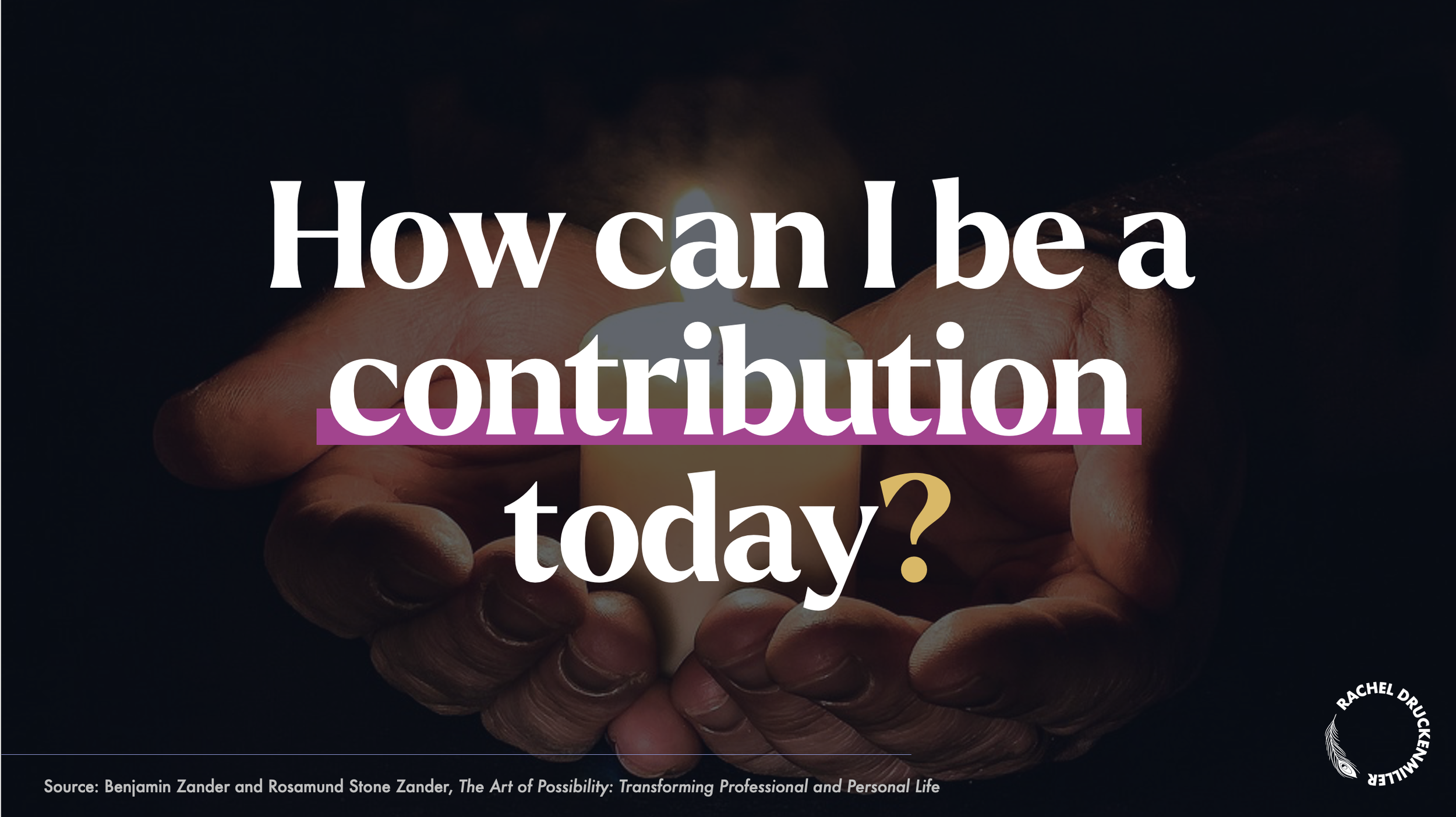
The Bonus Question: How can I be a contribution today?
This question brings all four together. It takes your purpose, your identity, your sense of possibility, and your character and asks: What do I do with all of that, right now?
In the months after my accident, this question kept me going. But it also led me somewhere I never expected.
I thought back to the nine-year-old girl who loved to sing alone in her room with her stuffed animals, never in front of another soul. In high school, I sat in the audience for all four years watching my peers perform in the concert choir, doing the thing I loved, because auditioning felt too risky. For the next fifteen years after college, I just sang at church occasionally but didn’t do much with music otherwise.
Then I got hit by a truck. And something in me shifted.
I started taking private voice lessons. A year and a half later, a producer I was working with looked at me and asked: What do you want to write your first song about? I told him I didn't know how to write music. He kept pushing. So I borrowed his belief in me and leaned in. I reminded myself of these two truths:
An invitation is an indication of a qualification.
You are not an imposter. You are in process.
With those thoughts in mind, I told him I wanted to write a song about being “Somebody” because so many of us walk around feeling like we don't matter, like we're not enough, like we're invisible.
Five months later, on January 26, 2023, I released my first original song, "Somebody." I was 38 years old. It took getting hit by a truck to finally give myself permission to become the kind of person I had always wanted to be.
You don’t need to wait until a blindside moment to accept the invitations that come your way. You don't need to have all the answers. You don't need to be perfect or even close to it. You just need to show up and borrow other people’s belief in you when you’re tempted to doubt yourself.
Here’s to reconnecting to our shared humanity and to the power of purpose, identity, possibility and legacy.
Here’s to getting back to what matters most.
————————
To learn more about the work I do as a keynote speaker, check out my speaking page to explore the topics I cover. I’d love to connect!